研究活動 2026-2030年度
第1回公開講演会「Development Ethics and the Question of "Worthwhile" Development: Perspectives in Practice」
2026年05月20日
 |
ポスターをダウンロード |
第1回公開講演会(共催:アメリカ研究センター)「Development Ethics and the Question of "Worthwhile" Development: Perspectives in Practice」
1st Public Lecture Anthropological Institute, Nanzan University (2026) Co-sponsored by the center for American Studies
Title: Development Ethics and the Question of "Worthwhile" Development: Perspectives in Practice
Speaker: Benjamin Huffman (University of Maryland)
Date: May 20, Wednesday 2026
Time: 18:00-19:30
Location: Anthropological Institute Building, Meeting room #102
Hybrid (In-person & Online)
Language: English

Abstract:
What is "worthwhile" development, and how can it be integrated into practice? This lecture approaches development ethics from a practical and anthropological perspective, emphasizing the importance of culture, values and capabilities in shaping development outcomes that are human-centric. Drawing on work from the Global Development and Design (GDD) stream at the University of Maryland's Office of Undergraduate Research, it highlights how students engage with real-world projects to critically examine the ethical dimensions of development. Particularly in relation to emerging AI technologies.
While AI can be seen as a shortcut to many solutions, it also risks reinforcing inequality and overlooking local knowledge, contributing to forms of "maldevelopment." Utilizing an anthropological lens can help recenter development around people rather than broad frameworks that have become industry standards.
Through tools like the Development Ethics Toolkit being developed by GDD, undergraduate research students translate ethical theory into practice, working as co-creators of innovative solutions. This lecture argues that worthwhile development should be at the heart of any development project, program or policy.
Report:
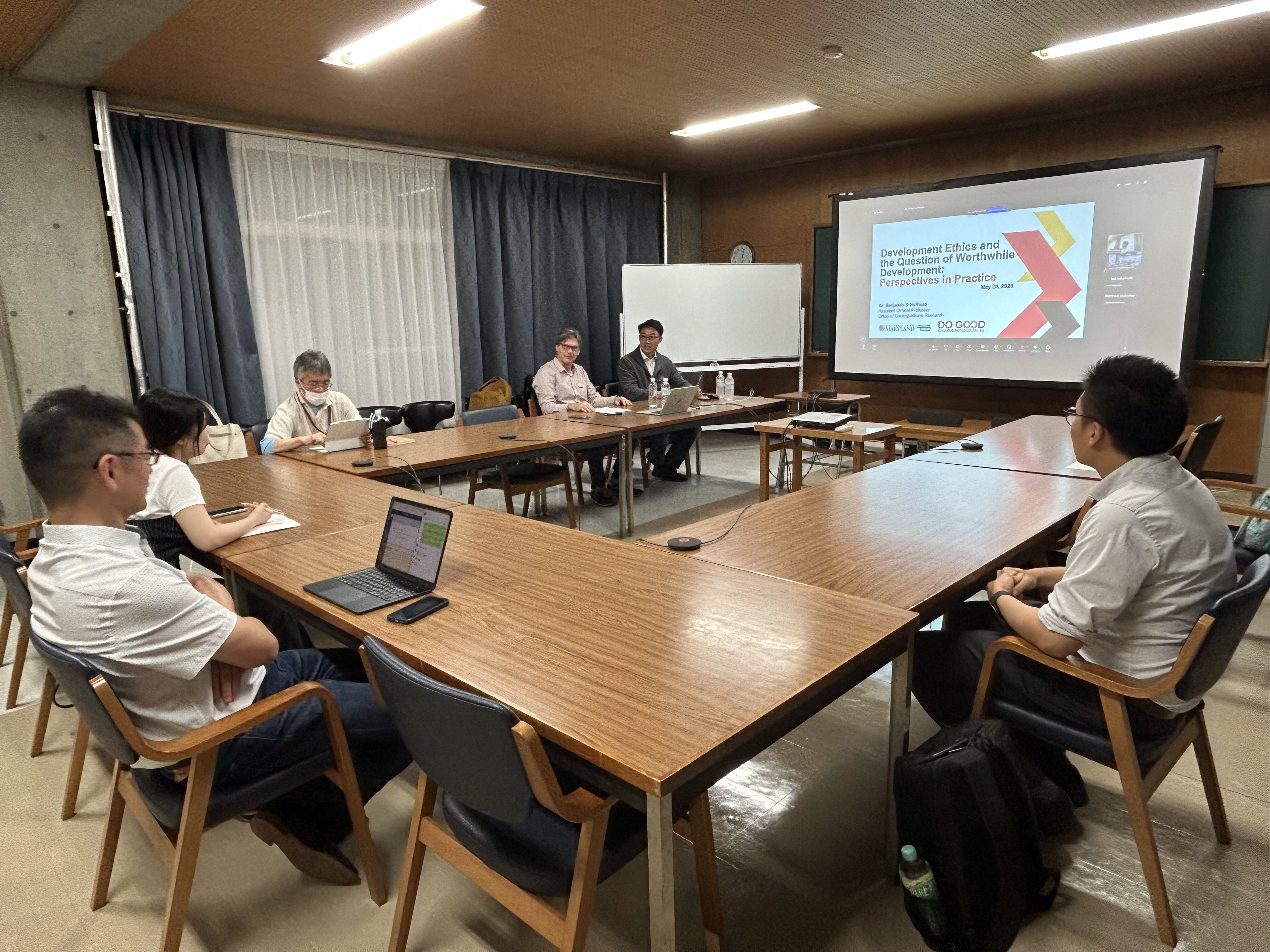
The Anthropological Institute at Nanzan University held its first public lecture of 2026 on May 20, featuring Dr. Benjamin D. Huffman of the University of Maryland. The lecture was attended by 13 participants, including 6 onsite attendees and 7 online participants via Zoom.
Dr. Huffman's lecture explored the field of development ethics and the question of what constitutes "worthwhile" development. Drawing on both professional experience and educational practice, he examined the ethical dimensions of development projects, policies, and technologies, particularly in relation to human-centered approaches and emerging AI technologies.
A central theme of the lecture was the distinction between "worthwhile development" and "maldevelopment." Dr. Huffman argued that development initiatives are often evaluated primarily in terms of economic growth, efficiency, or technological innovation, while ethical considerations such as human well-being, agency, cultural freedom, environmental sustainability, and social responsibility are treated as secondary concerns.
The lecture also introduced the work of the Global Development & Design (GDD) stream within the University of Maryland's FIRE (First-Year Innovation & Research Experience) program. Dr. Huffman discussed how undergraduate students participate in collaborative, research-based projects that combine development ethics, design thinking, technology, and policy analysis. Particular attention was given to the Development Ethics Toolkit, an open-access project that seeks to integrate ethical reflection into the design and evaluation of development initiatives.
The talk further addressed the relationship between artificial intelligence and development practice. While AI technologies are often promoted as efficient solutions to social and economic problems, Dr. Huffman cautioned that such systems can also reinforce inequality, overlook local knowledge, and contribute to forms of "maldevelopment" if ethical considerations are not incorporated into the design process itself.
Drawing on case studies including the Flint Water Crisis, the Kariba Dam project, and the Chisso Corporation pollution disaster, Dr. Huffman llustrated how development failures frequently emerge when administrative efficiency, economic priorities, or technological systems are prioritized over human well-being and community trust.
The lecture generated thoughtful discussion among participants regarding the role of ethics, culture, participation, and technology in contemporary development practice, as well as the potential contributions of interdisciplinary and anthropological perspectives to these debates.